Dacity Coin is an in-game currency featured in GTA VI’s AudaCity storyline. A game guide by VGC describes earning DCTY through AudaCity events and using the balance within the game’s mission sequence. Real tokens using Dacity or GTA VI branding are separate crypto assets created by third parties; a matching ticker or image does not establish a relationship with Rockstar Games.
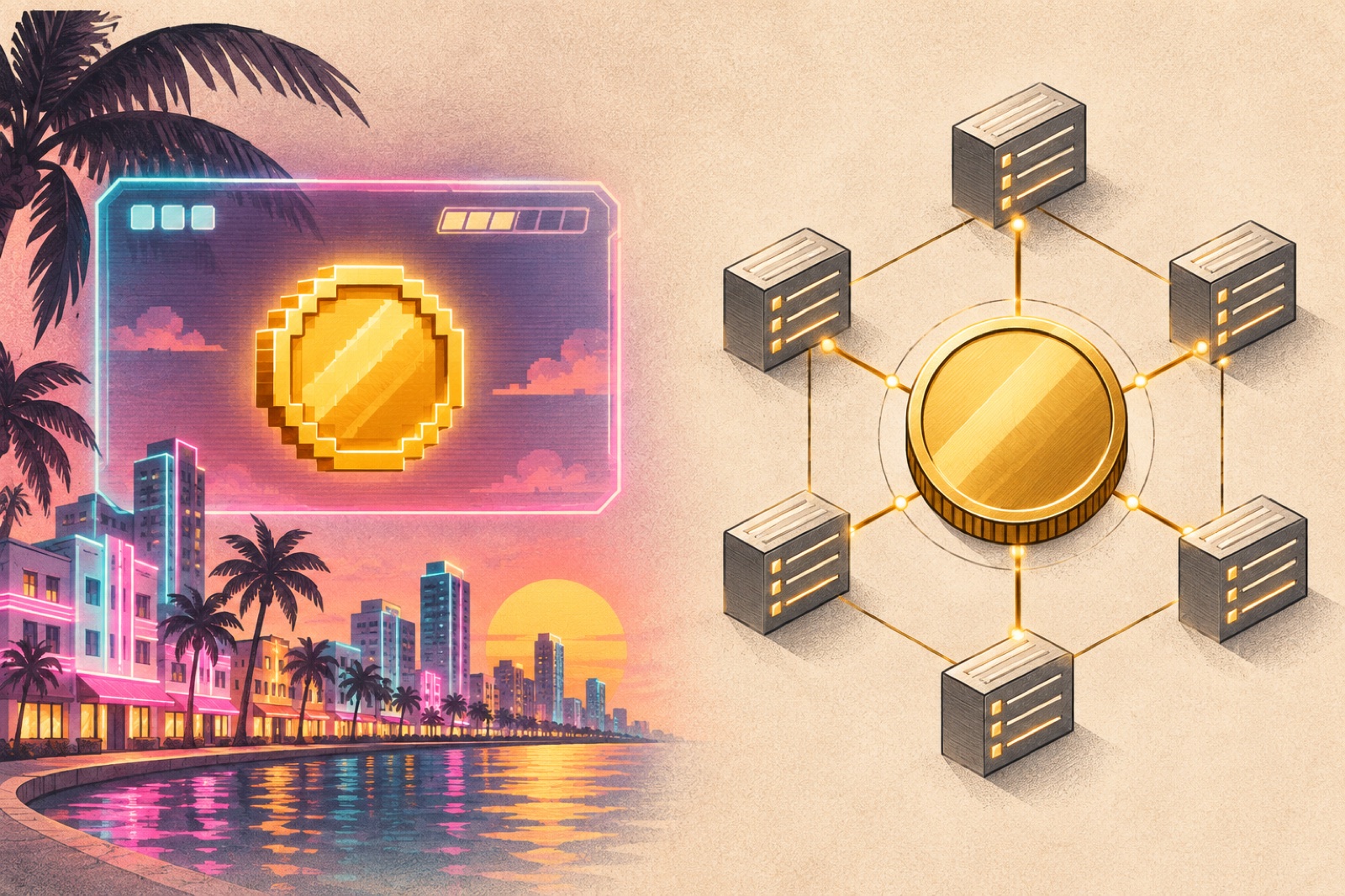
What players encounter in GTA VI
Rockstar’s launch trailer introduced the fictional AudaCity brand and its coin as part of the game’s satire of online investment culture. After release, VGC’s gameplay guide described a related sequence in which players earn Dacity Coin through Papa AudaCity events and see an in-game balance and value. That is evidence of a game mechanic and a fictional economic story. It does not, by itself, establish that the balance is a transferable asset outside the game.
The distinction is familiar from other games: a displayed balance can be stored and updated by the game’s own systems. Players may earn, spend, or lose it under game rules, without owning a blockchain token or having a way to withdraw it as dollars. For Dacity Coin, the available gameplay reporting describes an in-game reward and cash-out decision within the mission—not a wallet address, public token contract, or external redemption process.
Rockstar’s official GTA VI launch-trailer page is the primary source for the game’s promotional material. For the specific AudaCity quest mechanics, VGC’s Dacity Coin gameplay guide provides a post-release account. The two sources answer different questions: one documents the official trailer, the other reports the playable mechanic.
In-game balance versus blockchain token
The word “coin” is used for both fictional money and crypto assets, but the word alone tells us very little about the underlying system. A real blockchain token has a contract or protocol representation that can be inspected on a named network. Its transfers are recorded according to that network’s rules. An in-game balance may instead be a record maintained by the game publisher and governed by the game’s own terms.
| Question | Dacity Coin in GTA VI | Third-party token using the name |
|---|---|---|
| Where is the balance represented? | Within the game’s fictional economy and gameplay systems | On a specified blockchain, if a token contract exists |
| Who defines its rules? | The game’s code and publisher-controlled environment | The contract, network, and whoever can administer the token |
| Can it be transferred outside the game? | Gameplay coverage describes an in-game balance; it does not describe external withdrawal | Potentially, subject to the contract, network, and available liquidity |
| Does the name establish Rockstar affiliation? | It is a fictional element in GTA VI | No. Similar names and artwork are not proof of authorization |
This is a useful way to examine any game-related asset claim. Ask for the network, contract address, issuer, transfer rules, redemption terms, and a primary source confirming the publisher’s role. If those details are missing, the phrase “official game coin” is a marketing assertion rather than a verified technical description.
Why real tokens appear around game launches
A highly visible fictional coin gives traders and token creators an easy narrative to reuse. Decrypt reported that crypto traders created an unofficial Solana token using the Dacity name and speculated about how prominent the fictional coin would be in the game. That market thesis depended on attention and assumptions about the story; the token’s name did not create a technical or commercial link to Rockstar.
Security researchers have documented a more direct risk. Malwarebytes found multiple crypto projects borrowing GTA VI’s name or artwork, including sites that asked visitors to connect a wallet. A wallet connection request is not a game login: signing a transaction or granting token permissions can authorize actions involving real assets. Before interacting, verify the domain and contract independently, read the exact wallet prompt, and decline requests whose purpose you cannot explain.
Rockstar’s roleplay-server policy addresses commercial use, virtual currency, and crypto assets in third-party roleplay servers. Its stated scope matters: a rule for community servers should not be presented as a technical description of a built-in single-player feature. For the latter, use observable gameplay and current first-party documentation.
A compact verification checklist
- Separate the fictional item shown in the game from any token trading under a similar name.
- For an external token, identify the chain and exact contract address; a ticker is not unique.
- Look for a direct Rockstar or Take-Two announcement before treating a token as officially connected.
- Check whether a wallet page asks for a signature or approval, and understand what that permission allows.
- Treat price, liquidity, and market-cap claims as time-sensitive snapshots, not proof of legitimacy.
For a broader framework on separating a project’s claims from its implementation, see Satin’s crypto whitepaper research method. For the underlying distinction between a shared transaction ledger and a centrally maintained record, the Bitcoin whitepaper guide explains the design questions that make blockchains technically distinct.
What this does—and does not—establish
Available post-release reporting supports a narrow conclusion: Dacity Coin is part of GTA VI’s fictional AudaCity storyline, while real crypto tokens that borrow the name are separately created market assets. A token’s market listing, community, or visual similarity does not demonstrate publisher involvement. Conversely, a fictional in-game currency does not automatically imply a blockchain integration. Keep those claims separate unless a primary source or verifiable implementation connects them.